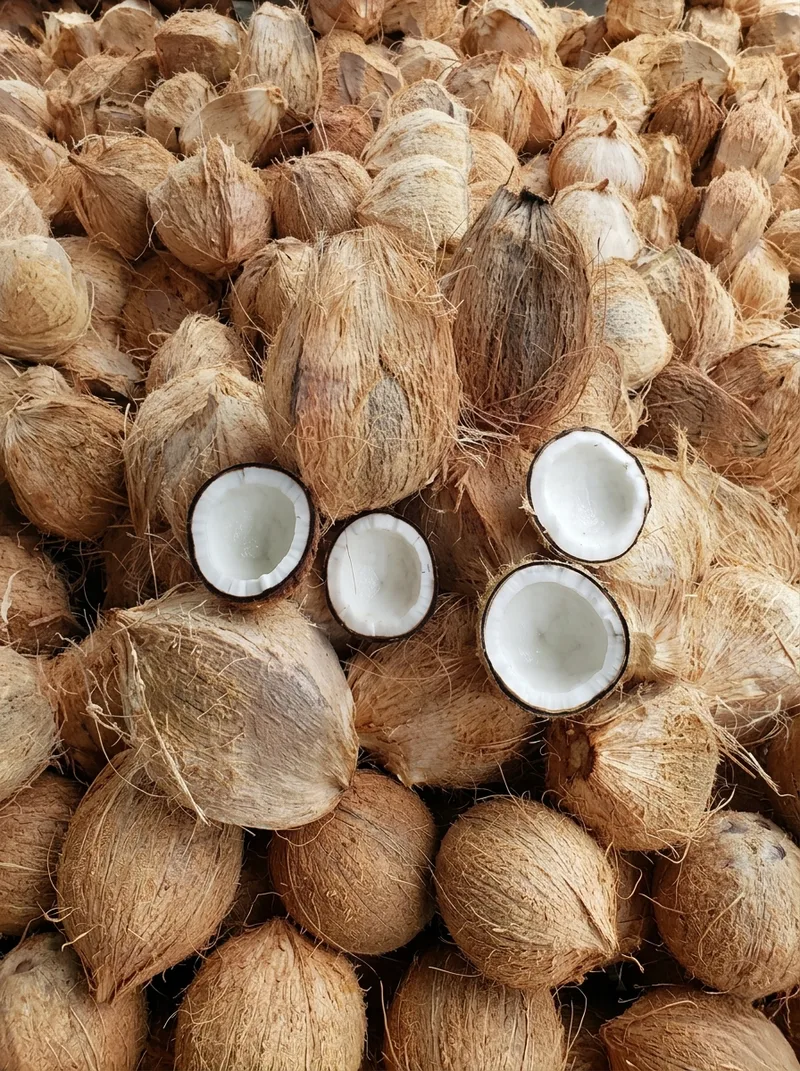
Semi Husked Coconut
India
Semi-husked coconut supply peaks during February–May and September–December, offering the best quality and volume. While available year-round, June–August often sees lower supply due to monsoon-related harvesting challenges
Coconut filled with high nutritional values that protect the body from diseases, it is also known as a 'Fruit of Life'. Semi Husked Coconut is ideal for various culinary purposes.
Why Indian?
High nutritional values that protect the body from diseases
Benefits
Ideal for various culinary purposes, increased shelf life due to semi-husking process
Uses & Applications
Semi-husked coconuts are mature, partially husked coconuts commonly used for culinary, industrial, and ceremonial purposes due to their ease of handling and longer shelf life. They are ideal for producing coconut milk, oil, grated meat, and direct consumption of water.
Characteristics
Health & Nutrition
Nutritional Value
Semi-husked coconuts are highly nutritious, providing approximately 350-360 calories per 100g, consisting mostly of healthy fats (approx. 33-36g), specifically medium-chain triglycerides (MCTs). They are rich in dietary fiber, manganese, potassium, copper, and iron, offering significant energy while containing no cholesterol.
Medicinal Properties
Semi-husked coconuts offer significant medicinal value through their nutrient-dense meat and water, containing medium-chain triglycerides (MCTs), electrolytes (potassium, magnesium), and high dietary fiber. They act as a natural antibacterial and antiviral agent, supporting immune function, digestive health, heart health, and weight management.
Varieties
Semi-husked coconuts are mature coconuts with the outer husk partially removed, leaving a protective, fibrous brown shell often weighing 500g–800g. Key commercial varieties in India include the Kalparaksha (disease-tolerant), Kalpa Suvarna (dwarf variety), and Chandra Kalpa (high-yielding). These are popular for export, culinary, and ritual use.
Specifications
Packaging
Semi-husked coconut exports, primarily from India (Pollachi/Tamil Nadu) and Southeast Asia, focus on mature brown, high-oil nuts (500g–800g) preferred for culinary, desiccated, and industrial use. Top varieties include West Coast Tall, East Coast Tall, Chandrakalpa, and VPM-3. These are favored for their 50-70 day shelf life and durable, brown, partially husked shells.
Safety Information
Semi-husked coconuts are mature coconuts with the outer fibrous layer partially removed, leaving the shell and sometimes a top layer of fiber intact to protect the eyes. They are generally safe for consumption when properly handled
Trust & Quality
Related Products
Green Chilli
📍 All over India
Green Chilli is another staple of Indian culinary gamut. After grasses, chilli peppers are perhaps the most diversified organic item with many varieties.
Lemon
📍 India
Indian Limes for export Indian lime (citrus) for export, primarily Citrus aurantifolia, is recognized for being 100% fresh, organic, and rich in Vitamin C, with a vibrant green color. Sourced largely from regions like Tamil Nadu, these limes are handpicked, washed, and packed using refrigerated, climate-controlled logistics for international markets like the UAE, UK, and Bangladesh
Okra (Lady's Fingers)
📍 Tropical and warm regions of India
Sourced from the tropical and warm regions of Indian, Okra is a perennial vegetable of immense popularity in India. Its fibrous roots and pods containing round white seeds transform into thick glutinous slime when cooked. India is the world's largest producer of okra (bhindi/ladyfinger), contributing over 60-70% of global production. In 2023, India's production was 7.158 million metric tons. India is also a leading global exporter of fresh okra, with significant shipments to the UK, Kuwait, and Germany etc