Home/Products/Mustard Seeds
Back to Products

Premium Quality Product

Global Export Rank: 3rd (approx. 7.86% share in 2023–24). Production Rank: India is consistently among the top 3–4 producers, competing with Canada, Russia, and Nepal. Top Producing State: Rajasthan contributes to nearly 40-48% of India's total mustard production.
Rice & SpicesSpices

Mustard Seeds

Origin

india

Season

Mustard seeds are a, cool-weather Rabi crop in India, with peak cultivation occurring during the winter season. Sowing typically takes place from October to November, with harvesting occurring from February to March.

Mustard seeds are small, pungent, round seeds from the Brassica plant family (related to broccoli and cabbage), widely used as a spice and for producing vegetable oil. Available in yellow, brown, and black varieties, they offer a sharp, tangy flavor and are commonly used in tempering (tadka) for Indian dishes or in making condiments.

Why Indian?

Intense Pungency: Black and brown mustard seeds have a sharper, hotter taste (up to 5x more intense than yellow). Authentic "Tadka": When heated in oil or ghee, they pop and release aromatic, nutty, and complex oils that are foundational for Indian dishes like dal, curries, and stir-fries. Richness: They add a robust, earthy, and spicy flavour that enhances vegetarian and meat dishes

Request Quote

Uses & Applications

Indian mustard seeds (Rai or Sarso) are a staple in Indian cuisine, primarily used for tempering (tadka) to add a pungent, nutty flavor to dals, curries, and vegetable dishes. They are essential in pickles, chutneys, and spice blends. Beyond cooking, they are used for therapeutic massages, relieving joint pain, and promoting digestive health

Characteristics

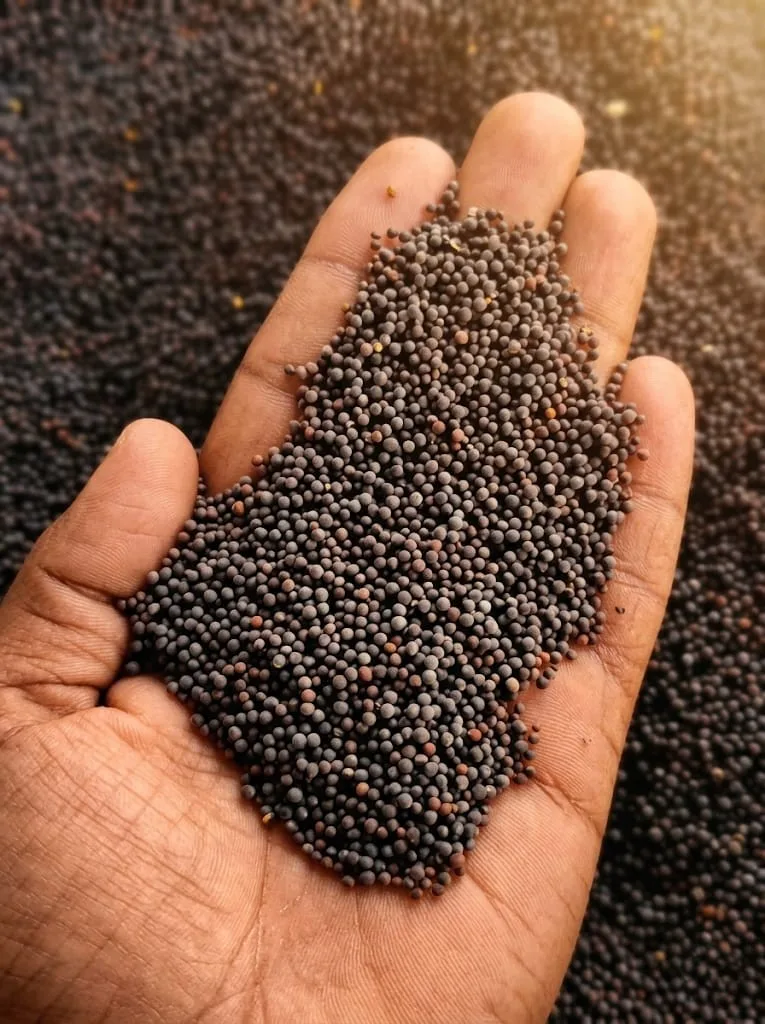
Texture:Indian mustard seeds (Brassica juncea) are small, 1-2mm, spherical seeds with a smooth, matte to slightly velvety surface texture. They are firm and dry to the touch, appearing as tiny brown to dark reddish-brown balls. When whole, they are hard and finely pitted, releasing a pungent, nutty aroma when crushed or tempered in oil.
Appearance:Indian mustard seeds (Brassica juncea), commonly used in Indian cuisine, are tiny, spherical, and about 1–2 mm in diameter. They appear reddish-brown, dark brown, or nearly black in color. When whole, they are hard, smooth to slightly pitted, and nearly odourless, releasing a pungent, nutty aroma only when crushed.
Flavor:Indian mustard seeds, commonly known as Rai (black/brown) or Sarson, deliver a sharp, pungent, and nutty flavor that becomes earthy and slightly bitter when toasted. They are essential for tempering (tadka), where heating them in oil releases a warm aroma and a nutty, spicy kick, providing a distinctive flavor base for curries, pickles, and dals

Health & Nutrition

Nutritional Value

Indian mustard seeds are highly nutritious, boasting roughly 500+ kcal, 20-28g protein, and 36-40g fat per 100g, while being rich in fiber (14g) and essential minerals like selenium, magnesium, and phosphorus. They are a powerhouse of antioxidants, particularly glucosinolates, which support immune health and possess anti-inflammatory, antibacterial, and anti-cancer properties.

Medicinal Properties

Indian mustard seeds (Brassica juncea), or Rai, possess significant medicinal value due to high levels of antioxidants, selenium, and magnesium. They are used to treat respiratory congestion, aid digestion, relieve joint pain (when applied as a paste), and help regulate blood sugar levels. These seeds are also rich in anti-inflammatory glucosinolates.

Cultural Significance

Indian mustard seeds (sarshapa) hold deep cultural, spiritual, and culinary significance in India, dating back to 4000 BCE. They are a cornerstone of daily tempering (tadka), symbolize protection against evil spirits, and represent fertility and prosperity in rituals. The seeds are also significant in Ayurvedic medicine and, historically, as a symbol of faith and small beginnings

Packaging

Indian mustard seed export packing typically involves 25 kg to 50 kg new polypropylene (PP) bags, multi-wall kraft paper bags, or jute bags, often with inner liners to maintain freshness and prevent moisture damage. Specialized packaging like 1 MT tote bags or 5–10 kg vacuum-sealed units are also used for specific buyer requirements

Safety Information

Moisture Content: Must not exceed 10% by mass (strictly 9% is often preferred) to ensure long-term stability and prevent molding. Purity & Foreign Matter: High purity levels, ideally 99%. Foreign matter (dust, dirt, stones, straw, other seeds) must be 1%. Grading: Graded on the basis of damaged, discolored, or shriveled seeds. Category I requires 1% damaged/discolored seeds. Contaminants: Must be free from Argemone seeds, which are prohibited due to safety risks. Volatile/Fixed Oil: For condiments, volatile oil is crucial. For oilseed, fixed oil content is the determinan

Additional Information

Contact company for detailed information

Trust & Quality

100% Authentic
Premium Quality
Global Export
Natural Source

Product Specifications

General Specifications

Storage TemperatureIndian mustard seeds (Brassica juncea) should be stored in airtight, opaque containers in a cool, dark, and dry location to maintain quality for 3–4 years. Ideal conditions are moisture and temperature. Tin containers or sealed, moisture-proof bags are best to prevent mold, pest infestation, and loss of pungent oils
Country of Originindia

Packaging Details

Box SizesIndian mustard seed packaging primarily utilizes flexible, moisture-resistant materials like PET (Polyester), LDPE (Low-Density Polyethylene), and BOPP (Biaxially Oriented Polypropylene) to ensure freshness, typically in heat-sealed, printed pouches. For long-term storage, aluminum foil pouches and tin containers are superior for maintaining quality, while jute bags are also used for bulk, traditional transport
Pack Typesndian mustard seed packaging primarily utilizes durable, moisture-proof, and heat-sealed laminated pouches for retail (50g to 5kg) to maintain freshness, while bulk quantities (25kg–50kg) are packed in jute, PP, or paper bags. These materials are tear-resistant, Key Packaging Options and Features: Materials: Durable plastic laminate, PET, jute, and paper bags are commonly used for packaging. Packaging Types: Pouches/Bags: Heat-sealed, stand-up, or center-seal pouches, often printed for retail. Bulk Bags: 25-50 kg jute or PP bags for industrial or wholesale purposes. Protection: Moisture-proof and air-tight, which is crucial for maintaining the quality and shelf life of the seeds.

Shipping Information

40ft Container LoadabilityIndian mustard seeds are commonly exported from India with the following container loadability capacities: 20 FT Container: Typically holds 19 to 22 Metric Tons (MT). 40 FT Container: Typically holds 27 to 28 Metric Tons (MT)

Related Products

Cumin Seeds

📍 Cumin seeds are the dried fruit of Cuminum cyminum, an annual herb in the parsley family native to the Levant and Eastern Mediterranean. Today, they are primarily cultivated in arid, hot climates, with India producing roughly 70%–90% of the world's supply, particularly in the Gujarat and Rajasthan regions

Cumin seeds (Cuminum cyminum) are small, elongated, yellowish-brown dried fruits (schizocarps) with 5-9 prominent longitudinal ridges and a pungent, warm, earthy flavor. As a staple spice in Indian, Middle Eastern, and Mexican cuisines, they are used whole or ground, often featuring in curry powders, stews, and soups.

Clove Pods (Lavangam)

📍 Cloves (Syzygium aromaticum) are not originally native to India, but rather to the Molucca Islands (Spice Islands) of Indonesia. They were introduced to India around 1800 A.D. by the East India Company, which established early clove cultivation in Courtallam, Tamil Nadu

Indian clove is the aromatic, air-dried,, unopened flower bud of the Syzygium aromaticum tree, widely cultivated in Southern India (Tamil Nadu/Kerala). It is characterized by a dark brown, nail-like shape, strong, pungent, sweet, and hot flavor, and high oil content (primarily eugenol). It is essential in Indian cuisine, Ayurveda, and for its antiseptic/numbing properties.

Black Pepper

📍 indian

Indian black pepper (Piper nigrum) is a premium, pungent spice derived from the dried, unripe berries of a climbing vine, primarily cultivated in the humid tropical regions of Kerala, Karnataka, and Tamil Nadu. Known as "King of Spices," it features a wrinkled, black, 5mm skin with a strong aroma due to high essential oil content.